
SEND
At Mile Oak Primary School, inclusion is central to who we are. We believe every child should feel a sense of belonging here, known, understood, valued and supported.
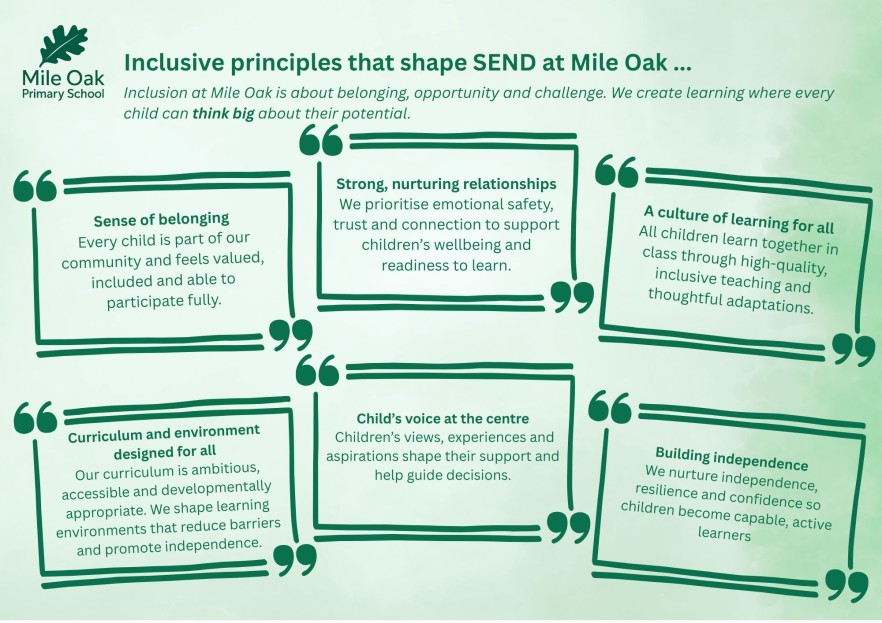
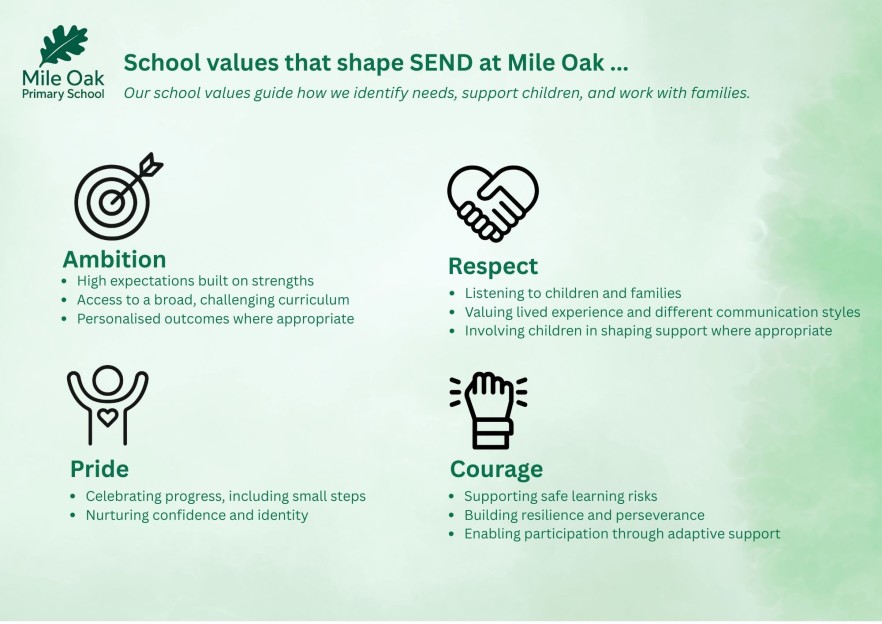
Our approach to SEND is shaped by the way we think, teach and learn as a community. At Mile Oak, we encourage children to think big about themselves, their futures, and what they can achieve. This is reflected in our core values of Ambition, Pride, Courage, and Respect, which underpin our inclusive practice.
We are committed to high quality inclusive teaching, strong relationships, thoughtful curriculum and environment design and placing children’s voice and independence at the centre of support. These principles guide our decisions so all children can grow as confident learners now and for the future.
We also recognise that SEND sits within a wider commitment to inclusion. Inclusion is about belonging, access, relationships and removing barriers so every child can participate, learn, and thrive. Some children may experience SEND alongside wider disadvantage. We link our SEND work with our Pupil Premium Strategy, which is also available here. Over time, this may be brought together further through a wider Inclusion Strategy.
Meet our Inclusions Team
Inclusions Team Contact Details
For specific SEND queries, please contact Miss Taylor using the details below.
Email: sendco@mileoak.brighton-hove.sch.uk
Telephone: 01273 077114
SEND Inclusive Principles and School Values
SEND Information Report
Below is our new SEND Information Report - broken down into easy to read sections - this explains how our SEND systems work in practice, what families can expect from the school and how we work in partnership with families so every child can thrive.
What types of SEND does Mile Oak Primary School provide for?
At Mile Oak Primary School, we support children with a broad range of Special Educational Needs and Disabilities. The way we describe needs follows the four areas set out in the SEND Code of Practice (2015), which is the statutory guidance all schools use when identifying and supporting SEND.
We also recognise that many children’s needs overlap or change over time. We look at the child’s whole profile before planning support and we hold regular reviews as a staff team. The examples below illustrate some of the types of needs or diagnoses we support. They are not a complete list, but they help show the range of needs we work with in our school.
Communication and interaction
This area includes difficulties with understanding or using language, processing spoken information, or interacting socially with others. Some children may find it hard to follow conversations, express themselves, communicate socially, or understand non-verbal cues.
Examples of associated needs include:
- Speech Sound Disorder
- Developmental Language Disorder (DLD)
- Autistic Spectrum Condition (ASC)
- Social communication differences
- Situational mutism
- Pragmatic language difficulties
- Stammering
Cognition and learning
All children learn at different rates. Progress is not always a straight or predictable line. It is normal for children to have times when they move more slowly, need additional practice, or revisit earlier learning. This does not automatically mean they have SEND.
Cognition and learning needs may be considered when a child shows ongoing, significant gaps in learning compared to their peers, or when they find it much harder than expected to acquire, retain, or apply new skills. Sometimes we notice a child is working significantly below the level typically expected for their age, even with high quality teaching and support.
These differences may relate to how a child processes information, remembers new learning, develops early literacy or numeracy skills, or manages problem-solving tasks.
- Dyslexia
- Dyscalculia
- Moderate Learning Difficulties (MLD)
- Global Developmental Delay (GDD)
- Working memory or processing differences
- Specific learning difficulties (SpLD)
- Significant and persistent gaps in learning compared to peers (for example, around 18 months behind expected development)
Social, emotional, and mental health (SEMH)
This area relates to how children regulate emotions, manage relationships, maintain wellbeing, or cope with day to day demands. Difficulties may affect behaviour, attention, confidence, resilience, or emotional regulation.
It is important to recognise that feeling anxious is a normal part of human experience. Children and adults will feel anxious in certain situations. This does not automatically mean they have SEND. We look for patterns where a child’s emotional needs become persistent or significantly affect daily life.
Examples of associated needs include:
- Anxiety
- Low mood
- Attachment needs
- Trauma-related needs
- ADHD or attention regulation differences
- Emotion regulation challenges
- Low self-esteem or confidence barriers
Sensory or physical needs
This area includes needs related to sensory processing, physical development, movement, coordination, or long-term medical conditions. These challenges may affect how a child is accessing learning, mobility, independence, or comfort in the school environment.
Examples of associated needs include:
- Hearing Impairment (HI)
- Visual Impairment (VI)
- Sensory processing differences
- Physical disabilities
- Fine or gross motor coordination needs - Dyspraxia or Developmental
- Coordination Disorder (DCD)
- Cerebral palsy
- Epilepsy
- Long-term medical conditions (for example, diabetes or asthma)
Some children have medical conditions such as diabetes, epilepsy, or asthma. When a child has a medical need, their support is planned through an Individual Healthcare Plan, which sets out the care they need in school. A Healthcare Plan on its own is appropriate when a child does not have SEND.
Some children also have intimate care needs. These are supported through an Intimate Care Plan. An Intimate Care Plan on its own is appropriate when a child does not have SEND.
A child may have SEND for different reasons. Sometimes a medical or physical need can lead to difficulties in one of the four SEND areas described above. In other cases, a child may have a SEND need that exists alongside a medical need. In both situations, SEND is identified through the child’s learning and developmental profile.
We work closely with families to understand the whole picture for each child so the right type of support is in place.
Some children are learning English as an additional language. Being new to English does not mean a child has SEND. Children learning English may show communication or learning differences while acquiring the language. This is expected and should not be seen as SEND.
A child is identified as having SEND only when they show underlying difficulties that cannot be explained by limited experience of English.
This might include:
- Persistent difficulty understanding concepts in any language
- Challenges processing information
- Difficulties with memory across languages
- Slow progress across the curriculum despite effective EAL support
We work closely with families to understand:
- A child’s language background
- Their development in their home language
- Their progress in English
- How both languages are used at home and in school
This helps ensure children are not misidentified as having SEND while still acquiring English.
Admissions and Accessibility
We welcome disabled pupils as part of our school community and work to ensure that all children can access learning and wider school life in a positive and inclusive way.
Our school admissions arrangements apply fairly to all children. Where a child has an Education, Health and Care Plan that names our school, they will be admitted in line with statutory requirements.
Our oversubscription arrangements ensure that disabled pupils and pupils with SEND are treated fairly.
Further details about how the Local Authority processes admissions, including a link to the Local Authority Statutory Policy, can be found on our Admissions page, please click here.
We take active steps to ensure that disabled pupils are not treated less favourably than their peers. This includes reasonable adjustments to support access to learning, routines and the school environment where needed, in line with our duties under the Equality Act.
We are committed to providing an accessible and inclusive school environment that values and includes all children and families. We work actively to remove barriers to learning and participation wherever possible.
Our Accessibility Plan focuses on three key areas:
- Improving access to the physical environment
- Increasing access to the curriculum and wider school life
- Improving access to information
This includes consideration of access to classrooms, playgrounds, shared areas, school trips and extra-curricular activities.
Practical adaptations may include step-free access where possible, adapted toilet facilities, flexible classroom layouts, visual signage and sensory-friendly adjustments where possible.
We aim to make all school activities as inclusive as possible. Where a child may need additional support to take part, we work with families to explore reasonable adjustments so that participation is supported wherever possible.
We work in partnership with families and, where appropriate, with the local authority and other professionals to plan adaptations for individual needs.
Support for Medical Needs
Some children with SEND also have medical needs. You can find more information about the different types of needs we support in the Types of SEND section earlier in this report. The information below explains how we support children who have medical needs in school.
We are committed to making sure that children with medical needs are properly supported so that they can play a full and active role in school life, remain healthy and achieve their potential.
Where a child has a medical need that requires support in school, this will be discussed with families so that clear arrangements can be put in place.
Some children will have an Individual Healthcare Plan (IHP). This is a written plan that explains:
- The child’s medical condition
- The support they will need in school
- How medication will be managed if needed
- What to do in an emergency
Healthcare Plans are developed in partnership with families and, where appropriate, with health professionals. They are reviewed regularly to make sure they remain up to date.
Medication is only administered in school when it is essential to do so. Clear procedures are in place for the safe storage and administration of medicines.
Where possible, medication should be taken at home before or after the school day.
Children with medical needs are supported to access:
- The curriculum
- School trips
- Physical education
- Extra-curricular activities
We work with families to make reasonable adjustments where needed so that children can take part as fully as possible.
If a child cannot attend school because of medical needs, we treat each child’s situation individually and design a bespoke plan, in partnership with their family. This would aim to retain the child’s sense of belonging and support their access to education – however that may look. Brighton and Hove’s Education Other than at School (EOTAS) Medical Needs Tuition Team may be involved through a referral process. If this resource is accessed, strict safeguarding processes still apply.
Further details about how we support medical needs in school can be found in the school’s Supporting Pupils with Medical Conditions and Administration of Medications Policies, which are available here.
Who will Support my Child?
Every teacher at Mile Oak Primary School is a teacher of SEND. Inclusive teaching requires creativity, flexibility, careful planning and a strong understanding of each child. We value the dedication our teachers show each day.
Teachers:
- Adapt teaching for different needs
- Build positive relationships
- Shape supportive learning environments
- Work with the SENDCo to match support to each child
Senior leaders are also teachers of SEND. They help ensure inclusion is visible in daily practice, decision making and the life of the school.
Support staff also play a vital role in meeting the needs of all children. Their work requires patience, flexibility and quick thinking. We value the skill they bring to learning and to the wider school day.
Support staff may:
- Work closely with individual children
- Lead small-group interventions
- Support learning in class
- Guide children during lunch or break times
- Help children feel safe, included and confident
Together they help create a school where all children can take part, feel they belong and make progress.
We want every child to grow as an independent and confident learner. Adult support is planned with care. It is used when needed and reduced when children are ready to take more ownership.
Children thrive when adults:
- Step in at key moments to scaffold and model
- Step back to allow independence
- Create space for safe risk-taking
- Support specific tasks or times rather than the full day
Ongoing one-to-one support is rarely the most effective model of support. It can limit independence or reduce opportunities to learn with peers. Our aim is to give each child the right support at the right time so they can build their own strategies and prepare for future learning.
Our Learning Mentor, Mrs Beach, provides pastoral support that helps children feel confident, calm and ready to learn. Some children spend time with her for short periods while others access support at key points through the year.
Not all children with SEN will work with Mrs Beach. She supports pupils based on their individual needs, which may include:
- Needing a safe space to talk
- Exploring emotions
- Joining nurture-based activities
- Taking part in friendship groups
- Building resilience or self-esteem
Her work helps children develop confidence, regulate emotions and feel secure in school.
For more details please see our Understanding the Role of the Learning Mentor document below.
Miss Taylor is the school’s Special Educational Needs and Disabilities Coordinator (SENDCo). She is a qualified teacher with twelve years of experience and has worked at Mile Oak Primary School since 2018.
Her responsibilities include:
- Leading the strategic direction of SEND across the school
- As part of the Senior Leadership Team, ensuring inclusion informs teaching and learning, curriculum design, behaviour and the wider culture of the school
- Supporting staff with identification of needs and planning effective provision
- Observing learning in classrooms to understand engagement and access
- Coordinating SEND paperwork and reviews, including Education, Health and Care Plans (EHCPs)
- Working with external professionals and ensuring their advice is used effectively
- Providing supportive guidance to children and families through the SEND process
- Organising and leading professional development for school staff
- Overseeing support and provision that helps children access learning and make progress
Miss Taylor can be contacted directly via email: sendco@mileoak.brighton-hove.sch.uk.
Class teachers remain the first point of contact for most day-to-day questions or concerns and families will usually be directed back to their child’s teacher in the first instance.
We work with a range of external professionals who help us understand children’s needs in greater depth and plan effective support. The SENDCo coordinates referrals, gathers information and liaises with services so support is timely and aligned with school provision.
Brighton and Hove Inclusion Support Service (BHISS)
We access support from:
- Educational Psychologists
- Social, emotional, and mental health practitioners
- Sensory needs specialists (hearing and vision)
- Autism and social communication specialist teachers
- Family support workers
- Language and literacy specialists
- Early years SEND specialists
- English as an Additional Language and Traveller Service
BHISS helps us understand needs and plan strategies that support learning and wellbeing.
NHS Speech and Language Therapy (SALT)
Supports children with:
- Speech sound development
- Understanding language
- Expressive language
- Social communication
Seaside View or West Sussex Development Centre
Provides multi-disciplinary assessments for:
- Developmental needs
- Medical needs
- Social communication differences
May also provide access to:
- Paediatrics
- Occupational therapy
- Physiotherapy
Mental health and wellbeing services
- Wellbeing Service: triage and short-term mental health support
- Schools Mental Health Service: in-school, low-level CBT strategies and guidance for families
- CAMHS: assessment and treatment for complex or urgent needs, including ADHD assessments where appropriate
- Right to Choose routes: NHS-approved pathways that some families may choose to use for ADHD or ASC assessment
Behaviour, engagement, and attendance support
Supports children who:
- Find routines or engagement difficult
- Need help with transitions
- Struggle with attendance
- Experience social communication needs affecting daily functioning
School health services
- School Nurse Team: supports with sleep, toileting, diet, long-term medical needs, and healthy routines
- Health Visitor Team: supports younger children with development, early health concerns, and family needs
Social care and family support services
Social workers may visit school when a child is part of an Early Help plan, Child in Need plan (CIN), or Child Protection plan (CP). They meet with staff, gather information, or speak with the child to help ensure education, wellbeing, and family support are coordinated. The SENDCo and senior leaders work closely with social care to plan joined-up support.
Young Carers support advisors
Young Carers Advisors may visit to support pupils who have caring responsibilities at home. They offer guidance, help identify needs, and liaise with school so adjustments and wellbeing support are in place.
Other occasional external support
We seek additional specialist support where possible and may, at times, host supervised trainee practitioners when these supports identified needs.
Some families choose to apply for Disability Living Allowance (DLA). Where a family has started an application, the school can support by providing information about a child’s needs in school.
To keep this manageable for staff and to ensure accuracy and consistency in the information shared, all requests for DLA evidence must be directed to the SENDCo.
Support from the school can include:
- A phone call with the SENDCo, where families share the DLA contact details and confirm what information is needed
- A written contribution to support an application, where appropriate
A phone call is always the quickest way for the school to contribute. Written contributions are completed alongside other statutory paperwork and priorities, so there will be a wait.
When we contribute to DLA evidence, we can provide factual information such as:
- Diagnoses we have been told about or that are documented
- The level and type of support used in school
- Referrals made and services involved
- Observations of a child’s presentation in school
Families may describe experiences at home that differ from what we see in school. We can report what families have shared, alongside what we observe in the school setting.
Life Long Learning and Staff Expertise
Safeguarding is central to our professional development work at Mile Oak Primary School. Every member of staff has a duty to protect children and we maintain a strong culture of vigilance supported by regular training. All staff and governors receive a full annual Child Protection refresher and additional safeguarding training through the year so that knowledge stays current and practice remains confident and consistent.
Our Designated Safeguarding Leads are:
- Luke Lording (Headteacher) Designated Safeguarding Lead (DSL)
- Hiedi Larter (Family Champion) DSL
- John Cosgrove (Deputy Headteacher) DDSL
- Rosalind Turner (Chair of Governors) Nominated Governor for Safeguarding
We invest in ongoing professional development so staff can meet a wide range of needs and support inclusive practice. Recent whole-school training includes:
- Neuro-inclusive practice
- Regulation and de-escalation
- Trauma-informed practice
- Emotion coaching
- Autism and anxiety
- Quality First Teaching for SEND
- Scaffolding approaches
- Oracy and spoken language development
- Makaton
- Visual impairment including CVI
- Sensory needs including deafness
- Medical needs such as epilepsy and diabetes
- Language and communication approaches such as NELI and Talk Boost
This professional development enables staff to understand how children learn, how they communicate and how to create environments where all pupils can access the curriculum.
Our Senior Leadership Team, including the SENDCo, leads on inclusive practice and contributes to city-wide improvement work. Leadership activity includes:
- The Headteacher’s participation in the SEND AP Change Programme
- Involvement in the Belonging Project
- Participation in the first phase of the city’s Internal Inclusion Spaces (IIS), helping shape city-wide approaches to developing inclusive environments
- SENDCo attendance at SEND forums across contexts
- Planned completion of the National Professional Qualification (NPQ) in SEND, in Autumn 2026–27
This work strengthens whole-school systems and supports the development of inclusive, equitable practice.
Mile Oak is an active member of the Thrive Together Schools Alliance. Through this partnership, staff and leaders:
- Collaborate across ten key strands of school life including SEND
- Share approaches, resources and professional learning
- Support each other to improve outcomes and reduce workload
- Contribute to collective improvement across the city
This shared work reflects our commitment to strong, sustainable and collaborative inclusion.
More information on the TTSA can be found here.
Identifying Needs and the Graduated Approach
When a concern is identified about a child’s learning, communication, behaviour or wellbeing, we follow a clear and supportive process. Families are kept informed throughout, using the school’s usual communication systems.
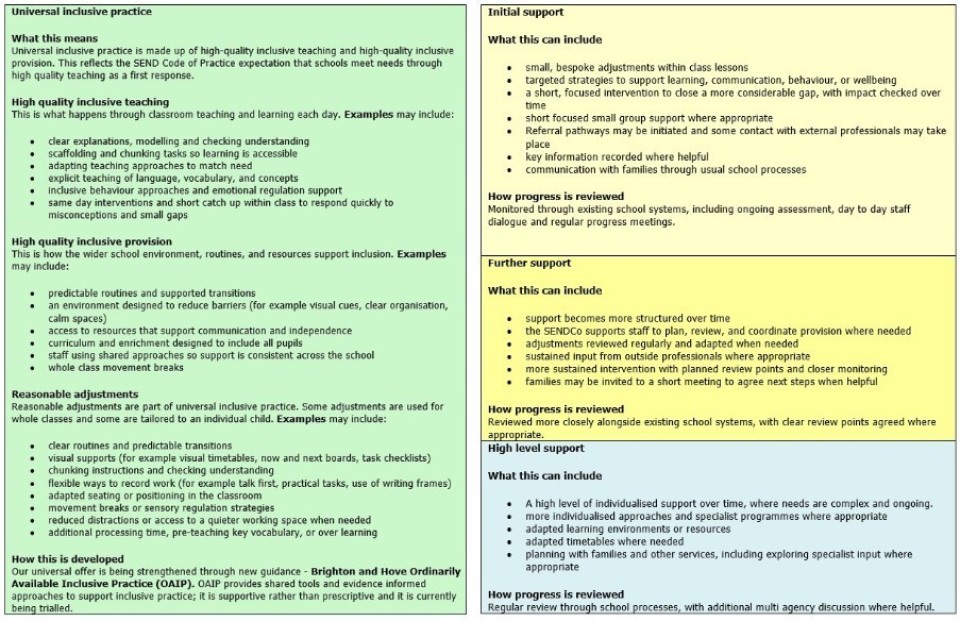
We always begin with high-quality inclusive teaching and reasonable adjustments. This is best practice for all children and where most children make the best progress. When a child needs support that is additional to or different from this, we use a graduated approach. This is statutory for all schools and describes the increasing levels of support that may be put in place over time, depending on need.
The graduated approach is needs-led, not diagnosis-led. These levels are not fixed thresholds or a step-by-step pathway. Children may move between them depending on their needs at that time. Universal inclusive practice remains in place for all children, with further support added when needed.
The involvement of external professionals does not automatically mean a child has reached a particular level of support. In the same way, an intervention does not by itself place a child at a certain level. What matters is the intensity, individualisation and duration of support over time.
Most support happens in the classroom. Progress is reviewed regularly by the class teacher, with SENDCo support where needed. Alongside the graduated approach, we also have a clear process for raising and tracking concerns, shown in the Concerns Flow section. We keep paperwork to what is useful and our focus is always on supporting the child.
Our key principles
- Every child is different
- Support is needs-led and reviewed regularly
- Most support happens in the classroom
- Support increases when needed
- Families are always involved through the school’s existing communication processes
- Progress is reviewed regularly by the teacher, with SENDCo support where needed
- Paperwork is kept to what is useful
- Our focus is always on supporting the child.
Monitoring, review, and paperwork
We monitor progress through our existing school systems, including ongoing assessment, day to day dialogue with staff and regular progress and pastoral meetings.
Where it is meaningful, we may use a pupil profile or a short support plan to clarify outcomes and strategies, support consistency and agree review points. Paperwork is kept to what is useful and families will be invited to contribute to termly reviews and support next step planning.
The levels above describe what support can look like when a child needs additional layers of help. The Concerns Flow below explains how concerns are raised, tracked, and reviewed over time. These sit alongside each other and are linked, but they are not the same thing. A concern can be raised at any time and it does not always mean a child will move to a different level of support.
Concerns Flow
Concerns can be raised at any time. To keep support consistent, we use a termly cycle of plan, do, review. This usually means an update and review in the autumn, a check-in and review in the spring and a check-in and review in the summer. We make contact sooner if needed.
Concern noticed or raised by home or school
↓
High-quality inclusive teaching and reasonable adjustments are reviewed
↓
Support is put in place and given time so its impact can be assessed
↓
Progress is monitored and reviewed through school systems, termly and sooner if needed
↓
Initial additional support is put in place if needed over time
↓
Further support is considered if needs continue over time
↓
High-level support and next steps are considered if needs remain high over time, including specialist advice before considering an EHC needs assessment
↓
EHCP reviews, if a child has an EHCP: termly progress reviews in school, with an annual review involving the teacher/ key adults/ professionals and SENDCo
The SEND Register is a way for the school to identify which children need SEN Support at that time. It helps ensure the right adults are aware of a child’s needs, and that support and review are coordinated.
Being on the SEND Register:
- Does not mean constant testing
- Does not mean lots of extra forms
- Does not mean support happens outside normal school systems
Being on the SEND Register does mean there is an identified SEN need in school and the school is putting in place support that is additional to, or different from, universal inclusive practice.
Children are added to the SEND Register with family agreement when:
- More support is needed over time, and monitoring shows this is required beyond universal inclusive practice, or
- An EHCP confirms that SEN Support is required in school, or
- In most cases, where a diagnosis is shared and it is clear that this results in SEN needs in school and requires SEN Support
Some children may be monitored through existing school systems before any SEND Register decision is made. This helps us understand needs properly and choose the right level of support before moving to formal SEN Support.
The Provision Map is a school document that helps us keep track of:
- Children who are being monitored
- Children who are on the SEND Register
- Any additional or specialist support in place
Children may be highlighted on the Provision Map while we are building a picture of their needs. If it becomes clear that higher-level support is needed over time, they may move to the SEND Register section. The Provision Map is updated regularly.
A Pupil Progress Meeting is a regular school meeting where teachers and senior leaders:
- Look closely at how each child is doing
- Identify any concerns
- Agree next steps and support
These meetings help ensure that children are not missed and that support is planned in a timely and consistent way.
Most discussions around progress and communication with families happens through the school’s normal review points.
- Parents’ Evening
- Termly pupil progress meetings within school
Additional meetings with the SENDCo are:
- Arranged when they are helpful or needed
- Not automatic
- Focused on reviewing what is working and what may need to change
This approach helps keep communication clear without creating unnecessary appointments or pressure.
We keep paperwork proportionate and purposeful.
- Not every child needs a written plan
- Profiles and targets are used only when they help
- Paperwork is used when it helps support your child — not automatically
Our focus is always on:
- Day-to-day teaching
- The child’s experience in school
- What is making the biggest difference in practice
We work in termly cycles so that children have time to settle into support before changes are made.
- Support is reviewed at least once each term
- Many children will stay at the same level of support for a full term so they have enough time to make progress
- Changes are usually made at review points so that support has time to work
This supports a shared understanding that:
- Support needs time to work
- Progress is checked regularly
- Escalation usually happens after a review, not before
In some cases, where needs are clear or urgent, support may increase more quickly. Families are always involved in these decisions.
Family and Child Involvement
If you are worried about your child at any point, the first step is always to speak to your child’s class teacher. This is explained in more detail in the previous section, which sets out how concerns are raised, monitored and reviewed.
We work closely with children and their families at every stage of SEND support. Your views and your child’s experiences help shape the support we put in place. Our SEND processes work within the school’s existing strong systems.
Our approach is designed to be meaningful, purposeful and sustainable.
Families are key partners in SEND support.
- Families share their views, concerns and priorities
- Families receive regular updates through normal school communication systems, such as Parents’ Evening
- Contact with the SENDCo takes place when it is helpful and needed, rather than as a routine expectation for all pupils on SEN Support.
- Ideas may be offered to try at home where this is helpful
- Advice from specialist professionals may be shared with families where appropriate
We aim to keep communication regular and clear, while also ensuring that meetings are purposeful and focused on what will make the greatest difference for the child.
This joined-up approach helps us to understand each child’s lived experience so that support remains practical, consistent and rooted in everyday school life.
We provide opportunities for families to access information sessions, practical workshops and parent forums. These are often offered in partnership with external specialists and include opportunities to explore areas such as communication, emotional wellbeing and inclusive practice, with families working alongside the
Children are involved in ways that are appropriate for their age and needs.
- Children are supported to share their views where helpful
- Children’s experiences in the classroom help inform decisions
- Children help to reflect on what is helping and what may need to change
Access to curriculum and wider school life
We aim to ensure that all pupils, including those with special educational needs, can access a broad, balanced and ambitious curriculum. The graduated approach described earlier in this report is the starting point for identifying and removing barriers to learning so that provision can be matched to need. High-quality inclusive teaching is the first and most important support for pupils with SEND. Teaching is planned to be clear, structured and accessible and reasonable adjustments are made within everyday teaching to support inclusion and reduce barriers to learning. These adjustments are part of our universal offer for all pupils.
Some pupils may need support that is additional to or different from universal classroom teaching. This is identified through the graduated approach and reviewed regularly. Additional support is used to address specific barriers to learning, engagement or emotional regulation and may include wider school interventions, short-term individual support, structured support at key points in the day, or advice from external professionals where appropriate.
Pupils with SEND are supported to take part in all aspects of school life alongside their peers. This includes lessons, physical education, playtimes, educational visits and extra-curricular activities. Universal and targeted support to enable access is described in the Curriculum Access section above and is applied consistently across all areas of school life.
Where this is not sufficient on its own, further modifications and additional support may be considered through the graduated approach described earlier in this report. This ensures that access continues to increase in line with individual need.
Further support may include:
- Additional adaptation of activities or environments
- Enhanced planning for visits or extra-curricular activities
- Short-term or targeted adult support to enable access
- Specialist equipment or resources where recommended
- Individualised risk assessment and planning where required
In some cases, specialist resources may be sourced following professional advice, such as radio aids for hearing support or specialist physical resources.
All decisions about access and participation are based on individual need, agreed with families and reviewed regularly to ensure that support remains appropriate, inclusive and effective.
Forest Class is a mainstream internal intervention space for a small number of children with complex or higher-level needs who require more than classroom-based support to access the school day. Children remain part of their base class, with the class teacher continuing to play a central role in their learning and relationships.
Forest Class is used as part of a planned package of provision to help children access learning and wider school life more successfully. It supports children to feel settled and regulated, while developing the skills they need for learning in class, including attention, communication, independence, managing change and positive relationships. Where external professionals are involved, their advice helps to shape the support provided. Forest Class is not a catch-up space for children who are simply working below age-related expectations.
Forest Class may be used at different points within the graduated approach. For some children, it may be introduced when needs are becoming more significant. For others, it forms part of a wider plan where needs are complex, long-term or having a substantial impact on everyday school life. Support is planned carefully and matched to need, so the amount of time a child spends in Forest Class will vary. Needs are reviewed regularly so that support can be adjusted and, where appropriate, children can spend more time in class over time. Places are limited, and placement is considered carefully to ensure the group remains calm, safe and supportive.
Children who access Forest Class:
- are usually still part of their base class, with the class teacher remaining central to their learning and relationships
- have a plan that is reviewed regularly, so support can be adjusted when needed
- receive support matched to need, so the amount of time spent in Forest Class will differ from child to child
- have their needs reviewed regularly so that, where appropriate, they can spend more time in class over time
- are placed carefully, because the group needs to work well together. Group dynamics are carefully considered to make sure the space remains calm, safe and supportive for all children
Reduced timetables are rare and only considered in exceptional circumstances as part of a wider support plan. They are only used where there is a clear reason linked to a child’s needs, wellbeing or safety. They are not used as a consequence and are not offered as a standard option.
Any reduced timetable must be time-limited, agreed jointly with the family, put in writing, reviewed regularly and monitored by the Local Authority. It must also be supported by appropriate risk assessments and a clear plan to return to a full timetable as soon as this is right for the child.
If a reduced timetable is agreed, we will:
- agree this with families in writing, with clear reasons, intended outcomes and review dates
- set an early first review and regular review points after that
- plan and support a return towards a full timetable as soon as this is appropriate
- ask safeguarding leads to complete the safeguarding risk assessment for the times when the child is not in school
- ask the SENDCo to complete the in-school risk assessment so that appropriate support and adjustments are in place while the child is in school
- involve other professionals where needed
- share information with the Local Authority, as reduced timetables are monitored
In exceptional cases, the Local Authority may be involved in arranging alternative provision for a child who is unable to access suitable education in school. In most cases, this would be linked to a higher-level Local Authority funding stream. Safeguarding processes remain central, and providers are monitored and approved by the Local Authority. Our priority is always to support children to access education in school wherever possible.
Curriculum access, participation in wider school life and the effectiveness of support are monitored as part of the school’s wider teaching and learning cycle and accessibility duties. This includes access to learning, clubs, trips, events, social times and the physical environment of the school.
The Headteacher has overall responsibility for ensuring that pupils can access the curriculum and wider school life. The Deputy Headteacher oversees curriculum quality and teaching and learning. Subject leaders monitor how well the curriculum is adapted within their areas. The SENDCo has specific responsibility for reviewing the quality of provision, teaching and support for pupils with SEND. The site manager contributes where access relates to the physical environment, premises or safety.
Monitoring activities include learning walks, book looks, reviews of planning, pupil progress tracking and pupil voice. These processes help the school to identify barriers, review the impact of support and ensure provision continues to match need through the graduated approach. Findings from monitoring inform staff development, provision planning and accessibility improvements.
Transitions
We recognise that times of change can be especially important for children with SEND. We work carefully with children and families to plan transitions in a supportive and individual way.
Children and their families are invited to a range of transition events. These provide opportunities to:
- Meet the leadership team and Reception staff
- Visit the classroom and environment
- Meet other children and families
Reception staff also work closely with your child’s previous setting. This may include visits to observe your child and gather information to help plan support.
Where helpful, families can request a meeting with the SENDCo to discuss any concerns or additional needs.
For some children with more complex needs, a phased entry may be discussed and arranged.
Based on early information and teacher assessment, some children may begin to access additional nurture or pastoral support where appropriate.
When children join the school at other points in the year:
- Children and families are invited to visit the school
- Families usually meet with the Headteacher
- A school tour is provided to help children become familiar with the environment
- A class buddy is assigned
- All key lunch adults meet your child
- Families may meet with the SENDCo to discuss any SEND concerns
We also contact your child’s previous school or setting to gather relevant information so that support can continue smoothly.
Where needed, a phased start may be discussed and arranged.
We recognise that moving to a new year group can feel exciting and sometimes unsettling for children with SEND. We plan transitions in a balanced and thoughtful way so that preparation supports children rather than increasing anxiety.
Our Approach
- All pupils are discussed in depth and teacher-teacher transition meetings – we have a series of meetings, every year
- All children have transition visits to their new classrooms. We have two whole-school change days every year
- access a transition booklet on the website with photos of new teachers, classrooms and shared spaces.
- Pupils on an enhanced transition pathway receive a printed booklet and additional support identified by the SENDCo or current teacher.
- Enhanced support focuses on informal relationship-building, such as:
- a daily hello
- a lunch-time check-in
- a short story visit during non-contact time
- Additional visits take place in the final week using assembly slots.
- Transition begins at a time that supports children and avoids unnecessary worry.
Class Lists and Staffing
- Class lists are created with careful consideration of group dynamics, individual needs and supportive relationships.
- Small changes can have a wider impact on class balance, so we consider needs carefully at both individual and whole-cohort level.
- Flexible working practices, including job shares, are a valued and effective part of our school. Job shares work well because teachers work together closely, bringing their own strengths while sharing routines and provision to ensure consistency for pupils with SEND. We plan these partnerships carefully so pupils experience continuity and feel secure.
How and When We Share Class Lists
- Children find out their new class during the final weeks of term.
- Families receive this information directly after the first whole-school change day
- This approach:
- allows children to experience the transition themselves so they can lead discussions at home
- supports a calm, child-led response
- reduces unnecessary build-up of anticipation over many weeks
Professional Information Sharing
- Teachers share detailed knowledge about pupils, including strategies that support learning and regulation.
- Key SEND information is held centrally so it transfers smoothly with each child.
Settling-In Period
- A settling-in period is expected and necessary.
- Children need time to build trust, understand routines and feel secure in their new environment.
- We recognise this can be harder for some pupils with SEND and appreciate families’ patience as relationships and routines establish.
In exceptional circumstances, a child may be educated outside their usual chronological year group. This is rare and is most often considered at early transition points, for example Reception into Year 1, where there is clear evidence this is in the child’s best interests. This is always agreed in partnership with families and the decision is recorded on CPOMS.
Where agreed, our usual expectation is that the child remains with that year group through primary school, particularly where needs are more complex. We will review this over time and consider a child’s readiness and wellbeing. If a child’s needs change and it becomes appropriate for them to re-join their chronological age group, we would discuss this carefully with families and plan any change in a supportive way.
We work closely with local secondary schools to support children as they move into Year 7.
For all children, a transition programme is in place during Year 6. For children with SEND, additional transition support may be arranged, which may include:
- Extra visits to the secondary school
- Small group visits, supported by adults
- Opportunities to meet form tutors or heads of year in advance
- Additional transition activities arranged by secondary schools / or Schools’ Mental Health teams
- Mentoring program for selected children
- Transition support with pastoral staff
- Targeted school-based work around confidence, safety or wellbeing
- Offer of parent meetings with the secondary school SEND team
Year 6 teachers meet with secondary school transition staff to share detailed information. For children with SEND, the SENDCo also meets with the SENDCo or Inclusion Lead at the secondary school for a detailed handover.
Y6 children with an EHCP have a thorough Phase Transfer Review where families and children can make their preferences for secondary education known – a record of this meeting and associated paperwork is always shared with the Local Authority by October half term.
All relevant SEND information and paperwork is transferred to the new school to support continuity.
When a child starts at our school with an existing Education, Health and Care Plan, we work closely with families, the local authority and any involved professionals to plan support carefully.
Where our school is named in a child’s EHCP, we have a legal duty to admit the child and to use our best endeavours to secure the provision set out in the plan.
This includes:
- Sharing information before the child starts
- Planning support and reasonable adjustments in advance
- Ensuring staff understand the child’s needs and strengths
- Putting in place the provision outlined in the EHCP and working with families and the local authority where adaptations are required
In some circumstances, there may be questions about whether the provision in an EHCP can be met fully within our setting. Where this is the case, this is discussed openly with families and the local authority so that appropriate next steps can be considered through the statutory process.
Where needed, an early review meeting may be arranged to make sure provision is working as intended.
Our aim is for every child with an EHCP to experience a positive and well-supported transition into our school community.
Additional Information
We are committed to creating a safe, inclusive and respectful school environment for all pupils. Bullying of any kind is not tolerated, including bullying related to special educational needs, disability, race, culture or identity.
Incidents are responded to promptly in line with the school’s Behaviour and Anti-Bullying Policies. Support is put in place for those affected, with a focus on learning, repair and preventing reoccurrence.
We recognise that pupils with SEND may be more vulnerable to bullying, prejudice or discrimination. Concerns are listened to, taken seriously and responded to appropriately so that appropriate support is put in place and children feel safe, valued and protected.
At Mile Oak, we recognise that it is not enough to be ‘not racist’. We are committed to anti-racist practice and continual reflection on our policies, systems and everyday practice to ensure equitable voice, outcomes and value for our Black and racially minoritised families.
Further details on the school’s Anti-Bullying Policy can be found here.
Children who are Looked After (LAC) and have SEND may experience additional barriers to learning and wellbeing and therefore receive a high level of coordination and support.
We work closely with the Brighton and Hove Virtual School, whose role is to promote the educational achievement and life opportunities of children in care, children previously in care and children with a social worker.
Support includes:
- Regular Personal Education Plan (PEP) reviews
- Close liaison between school, SENDCo, Designated Teacher and social worker
- Consideration of emotional wellbeing, attachment and trauma-informed practice
- Priority access to support where barriers to learning are identified
Where a child also has an Education, Health and Care Plan, the school works closely with the local authority to ensure provision is implemented and reviewed.
We work with a range of external education, health and care professionals to meet pupils’ needs. Families are involved in decisions about referrals and information is shared in line with consent and data protection procedures.
If there is a difference in views about SEND provision or an EHCP process, families can access impartial advice and mediation.
Support is available through:
- ENDIASS – independent SEND advice via the Brighton and Hove Local Offer
- Amaze – information, guidance and family support via the Amaze website
Further information is available through the Local Offer (see below).
Our SEND provision sits within the Brighton and Hove Local Offer, which brings together information about education, health, social care and community services. Information can be found here.
Families may also find the following support helpful and can access these services directly through their websites.
Local and National Support Services
- School Nurse Service – via the local authority and school
- Brighton and Hove Wellbeing Service – via the NHS wellbeing website
- Amaze – SEND information and family support
- SENDIASS – independent SEND advice via the Local Offer
- Brighton & Hove Family Help (Right Support at the Right Time) – early help for families
- NSPCC – safeguarding, parenting support and advice
Specific and Needs-Based Support
- YoungMinds – youth mental health
- SIBs – support for siblings of children with SEND
- ADHD UK – information and peer support
- National Autistic Society – autism information and family support
- Girl with the Curly Hair Project – neurodiversity resources and workshops
- Winston’s Wish – bereavement support
- mASCot – peer support for autistic and neurodivergent families
Financial and Practical Support
- Family Action – practical, emotional and financial support
- Family Fund – grants for families raising disabled or seriously ill children
This list is not exhaustive and services may change over time. The SENDCo can provide further guidance where needed.
Family Champion
Families can also reach out to Hiedi Larter, Family Champion, who offers supportive conversations, guidance and signposting to services that can help with wellbeing, routines, attendance or wider family needs. The Family Champion works alongside the SENDCo and pastoral team to ensure families receive the right support at the right time.
Further information can be found here.
To ensure swift responses, equitable access and accurate tracking, all communication is logged by the admin team and directed to the appropriate member of staff.
Important Information for Families
- Teachers are usually unable to discuss concerns at the start or end of the day, as they are preparing for learning and ensuring children are safe and happy.
- All communication should go through the school office email: office@mileoak.brighton-hove.sch.uk
Stage 1: Class Teacher
Most compliments and concerns should be directed to your child’s class teacher.
Please contact the office to request:
- an email message to be passed on
- a telephone call
- a face-to-face appointment
If the matter is not resolved, the office can arrange for it to be escalated.
Stage 2: Senior Leader
- SEND-related concerns will be passed to the SENDCo.
- Other matters will go to the relevant member of the Senior Leadership Team.
If further support is needed, families may request escalation.
Stage 3: Headteacher
Concerns or compliments that cannot be resolved at earlier stages will be directed to the Headteacher and an appointment will be arranged.
Response Times
Staff aim to acknowledge contact within two working days. If a meeting is required, this will be arranged at a mutually convenient time.
Further details about communication and raising concerns can be found here.
To ensure that support remains safe, appropriate and effective for all pupils, families are asked not to send in equipment or resources from home without discussion and agreement with the school, for safety and consistency.
All classroom and regulation resources must be suitable not only for individual pupils but also for use within whole classes that include a wide range of needs.
Resources are selected through assessment, trial and review to ensure they support learning, are safe to use in busy classroom environments and do not create unintended barriers for other pupils.
This approach allows staff to monitor impact and ensure consistency across the school day.
If parents feel that a particular resource may support their child, they are encouraged to discuss this with the class teacher so that it can be considered safely, fairly and in the context of the wider learning environment.
This SEND Information Report is reviewed annually by the SENDCo and senior leaders, with oversight from governors.
Susan Wright is our nominated Governor for SEND.
SEND Information Report coming soon
SEND Policy coming soon
A. Key People (A–Z)
- DSL – Designated Safeguarding Lead responsible for child protection.
- Family Champion – offers guidance, signposting and practical support.
- Learning Mentor – supports wellbeing, regulation and engagement.
- SENDCo – coordinates SEND support and referrals.
- Social Worker – works with families on Early Help, CIN or CP plans.
- ELSAs – Emotional Literacy Support Assistants supporting emotional regulation.
B. Plans and Processes (A–Z)
- APDR – Assess, Plan, Do, Review cycle used to plan SEND support.
- CP Plan – Child Protection Plan
- CIN Plan – Child in Need Plan
- EHCNA – Education, Health and Care Needs Assessment.
- EHCP – Education, Health and Care Plan.
- OAP – Ordinarily Available Provision expected in mainstream schools.
- Provision Map – document outlining the support a child receives.
- SEN Support – additional support for pupils without an EHCP.
C. Needs and Difficulties (A–Z)
- ADHD – Attention differences, with hyperactive or combined presentations.
- ASC – Autism Spectrum Condition.
- CVI – Cerebral Visual Impairment (visual processing difference).
- DLD – Developmental Language Disorder.
- SEMH – Social, Emotional and Mental Health needs.
- SLCN – Speech, Language and Communication Needs.
- SpLD – Specific Learning Difficulties such as dyslexia or dyspraxia.
D. Professionals and Services (A–Z)
- BHISS – Brighton and Hove Inclusion Support Service, including EPs, SEMH practitioners, sensory specialists, autism teams, literacy and language specialists and early years SEND support.
- CAMHS – Child and Adolescent Mental Health Services for complex or urgent mental health needs.
- EALTS – English as an Additional Language and Traveller Service.
- EOTAS – Education other than at School
- EP – Educational Psychologist.
- IIS – Inclusion Spaces initiative supporting inclusive environments across the city.
- SALT – NHS Speech and Language Therapy service (speech sounds, understanding language, expressive language, social communication).
- Wellbeing Service – early mental health support, including triage and short-term interventions.
E. Support Routes and Organisations (A–Z)
- Amaze – SEND information and family support.
- Family Action – practical, emotional and financial support for families.
- Family Fund – grants for families raising disabled or seriously ill children.
- Girl with the Curly Hair Project – neurodiversity resources and workshops.
- mASCot – peer support for autistic and neurodivergent families.
- Right to Choose – NHS scheme offering alternative providers for ADHD or autism assessments.
- SENDIASS – independent SEND information, advice and support service.
- SIBs – support for siblings of children with SEND.
- Winston’s Wish – bereavement support.
- YoungMinds – youth mental health support.
F. Medical and Developmental (A–Z)
- Occupational Therapy (OT) – supports sensory processing, motor skills and functional tasks.
- Paediatrics – medical assessment and support for children’s health and development.
- Physiotherapy – support for physical development, mobility and movement.
SEND Support for Families and Useful Websites
For further SEND support, including useful websites and information on our parent-led SEND support group MOSAIC please click here.