Phonics
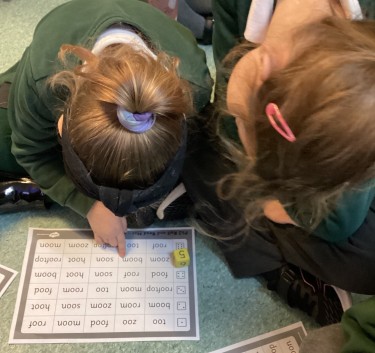
At Mile Oak, we believe that the acquisition and application of phonetic knowledge underpins and compliments successful early reading and writing, enabling children to achieve success and gain full access to the enriched curriculum offered.
Children will learn the skills to decode and read words, through our systematic, synthetic phonics programme.
How will we achieve our aims?
From the first day in reception, children will learn to read words through learning grapheme-phoneme correspondence. Children will also learn ‘tricky words’. These are words they are not yet able to decode using their learned sounds.
We have built a progressive and structured, personalised programme using the Letters and Sounds guidance with cued articulation actions to reflect the shape of the mouth / air flow needed to produce the sounds. This program means children can blend sounds to read words quickly and children are taught to move from segmenting and blending to automatic reading as soon as they are able to.
Phonics sessions in reception are taught daily at 9am for 20 minutes. Children are split into groups, responsive to their needs.
All children gave the opportunity for daily repeated practice and some children are identified for daily boost sessions to develop core skills and secure retention.
When children are segmenting and blending confidently, they are given a decodable book which is used for reading teaching in school and then sent home for home reading.
In year one and two, we teach phonics in ability streamed groups across both year groups, for half an hour every morning and again for 20 minutes every afternoon. Each session follows a structure of revisit, teach, practise and apply. Children are assessed every half term and groups are reorganised accordingly.
When children have completed the phonics program and are secure with all graphemes and alternative spellings and pronunciations, they move on to specific spelling lessons. Daily, keep-up sessions are delivered for any children identified as not making appropriate progress.
Phonics sessions in year 1 and 2 are supported by workbooks, which the children work through. A copy of this workbook is sent home for repeated practise alongside a decodable reading book.
How will we know that we have achieved our aims?
Half-termly phonics assessments track children’s progress through our phonics programme and groups are adapted accordingly.
Strong outcomes at the end of Year 1 in the Phonics Screening Check and end of KS2 SATs, which are consistently above national averages, show that our children have an excellent grasp of phonics and pupil voice reflects that our children have a positive attitude to phonics.
Phase 2 Phonics
Watch the below videos to help you support your child with their Stage 2 phonics.
s-a-t-p-i-n print
s-a-t-p-i-n cursive
m-d-g-o-c-k print
m-d-g-o-c-k cursive
e-u-r-h-b-f-l print
e-u-r-h-b-f-l cursive
Consonant digraphs print
Consonant digraphs cursive
Phase 3 Phonics
Watch the below videos to help you support your child with Stage 3 phonics.
j-v-w-x-y-z-zz cursive
j-v-w-x-y-z-zz print
qu-ch-sh-th-ng cursive
qu-ch-sh-th-ng print
ai-ee-igh-oa-oo-oi-ow cursive
ai-ee-igh-oa-oo-oi-ow print
ar-or-ur-ear-air-ure-er cursive
ar-or-ur-ear-air-ure-er print
Queries
The school's Phonics Leader is Miss Griffiths.
If you have any questions about the school's Phonics curriculum, contact your child's class teacher or Miss Griffiths via the school office.